
Piqued My Interest: Insights from the Antitrust Division’s Recent Statements of Interest


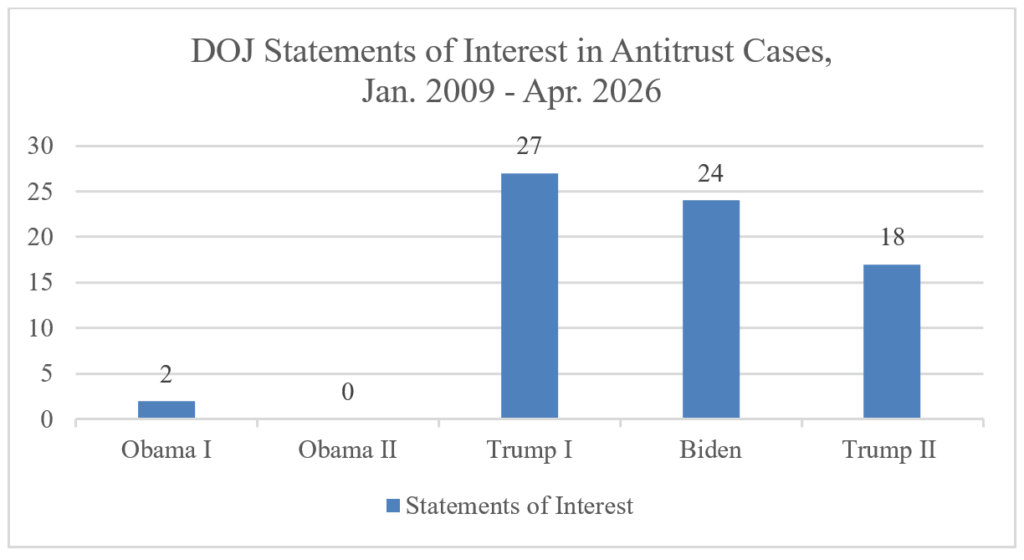
The Trump II Department of Justice Antitrust Division filed thirteen Statements of Interest in private antitrust cases during its first year back in office, and it has shown no signs of slowing down. DOJ filed five Statements of Interest in separate private actions in the first few months of 2026, suggesting the Trump II Administration may exceed its prior high-water mark for use of this tool to signal its view of the federal antitrust laws. These Statements, which explore diverse issues, affect not only the private litigants, but may also instruct businesses interested in DOJ’s current views, priorities, and focus.
Background on DOJ Statements of Interest
DOJ and FTC have long had authority to file Statements of Interest in matters of importance to the federal antitrust enforcers. In filing a Statement of Interest, the enforcement agencies do not take a position on the merits of the case. Rather, Statements of Interest are a mechanism to notify the court of the government’s position on issues raised by litigating parties. Unlike filing an amicus brief or formally intervening, Statements allow enforcers to advance policy interests and legal interpretations while committing only limited resources to a particular matter. Notably, the enforcement agencies can file Statements in any pending state or federal court case.
Historically, the Antitrust Division has not made meaningful use of this tool. Between 2009 and 2017, the Division filed only two Statements of Interest. Beginning with the first Trump Administration, the Division began using Statements of Interest more frequently to advance its policy and legal positions through private litigation. The Division filed five Statements of Interest in 2018, followed by a record eighteen Statements in 2019. While the Division did not file any Statements during the first year of Biden’s term, it filed twenty-four by the end of the Biden Administration. The second Trump Administration has picked up where the Biden enforcers left off, filing thirteen Statements in its first year. In all, DOJ has filed over sixty-five Statements in antitrust cases since 2018.
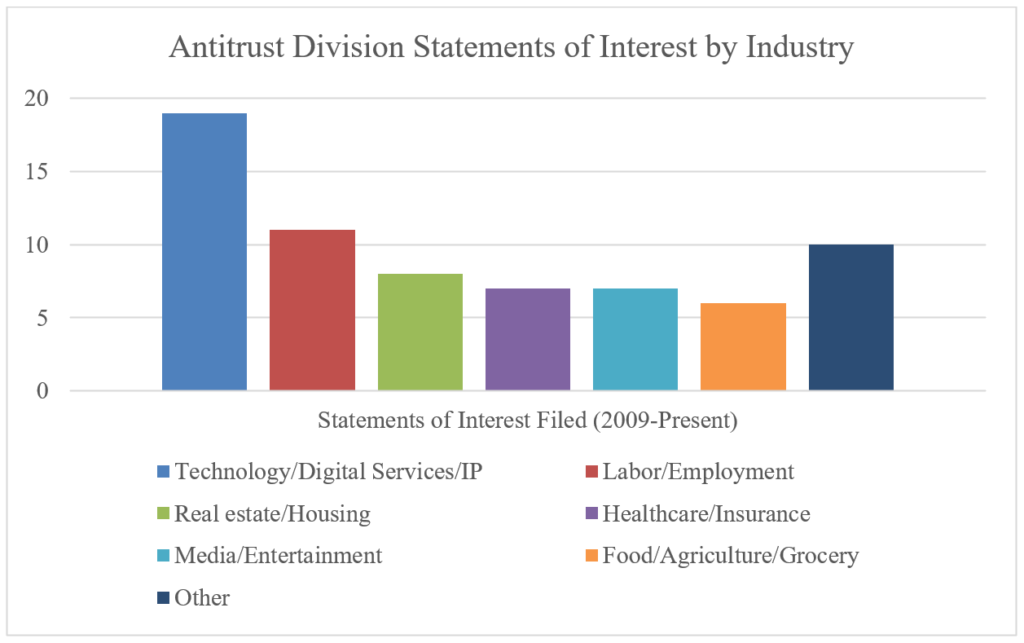
In the aggregate, the Antitrust Division has filed Statements of Interest in certain industries more frequently than others. These filings most often involve parties in technology, digital services, and intellectual property. Other industries with a greater number of Statements of Interest also include real estate and housing, healthcare and health insurance, and agriculture, food, and grocery. Unsurprisingly, attention to cases in these industries mirrors the Antitrust Division’s stated enforcement priority over the last several presidential administrations: a focus on pocketbook issues, where technology is defined as a key pocketbook issue that directly impacts the daily lives and finances of American consumers.
Regardless of the industry, understanding the relevant legal issues and DOJ’s arguments can offer important insights into the Division’s current legal views.
Enforcement Priorities and Key Takeaways
1. Support for patent holders
While the Biden Administration took several stances against patent holders, particularly in the pharmaceutical area, DOJ’s Statements of Interest in Collision and Samsung may signal a return to a stronger view of patent rights. This view aligns with one of the Trump Administration’s stated goals of supporting American innovation, particularly in response to international competition. Businesses may expect DOJ to take more patent-holder-friendly positions in the coming years.
Collision Communications Inc. v. Samsung Electronics Co.
Collision sued Samsung for infringement of its smartphone technology patents and a jury awarded it $445.5 million in damages. Following the jury verdict, Collision sought an injunction permanently blocking Samsung from future patent infringement. Samsung objected, arguing that as a non-practicing patentee, Collision had only ever expected to license its patent and so monetary damages, instead of injunctive relief, was sufficient. DOJ and the U.S. Patent and Trademark Office filed a joint Statement of Interest, explaining their view that non-practicing entities can suffer irreparable harm from infringement, and that courts should assess harm and remedy sufficiency during injunction proceedings according to traditional equitable principles.
Samsung Electronics Co. v. Netlist, Inc.
Among its allegations, Samsung claimed that semiconductor firm Netlist failed to abide by the terms of Netlist’s standard essential patents, violating the antitrust laws. Samsung contended that Netlist’s patents conferred market power and Netlist’s false assurances to the standard setting organization that it would license its patents on reasonable and non-discriminatory (“RAND”) terms constituted exclusionary conduct.
In its Statement of Interest, DOJ disagreed on both counts. Relying on a prior Statement filed in Disney Enterprises, Inc. v. Interdigital, Inc., DOJ argued that (i) incorporation of a patent into a standard, standing alone, is insufficient to infer the patent holder has market power and (ii) breaking contractual obligations or charging above RAND does not necessarily constitute exclusionary or anticompetitive conduct under the antitrust laws.
2. Support for workers and protection of labor markets
DOJ’s Statement in Herzog reaffirms the Division’s ongoing interest in labor markets and restrictions on workers, which emerged as an important priority in the Biden Administration and remains a stated enforcement priority for the Trump Administration. It also offers an important reminder to approach competitor collaborations with caution, especially when pro-competitive justifications are not obvious.
Herzog v. Fluor Federal Services, Inc.
Herzog involves a dispute over whether a “hybrid” agreement with both horizontal and vertical elements should be assessed under the per se test for antitrust illegality. Plaintiff alleged that certain FEMA emergency response and recovery contractors entered into per se illegal horizontal no‑poach and wage‑fixing agreements. Defendants argued that the alleged agreements were “hybrid” restraints, neither horizontal nor vertical, thus the per se rule did not apply. Moreover, defendants claimed the restraints were ancillary to a procompetitive collaboration.
DOJ filed a Statement of Interest that rejected the concept of a “hybrid” agreement, contending that any agreement with horizontal elements should be treated as horizontal for purposes of applying the per se test. DOJ also argued that as an affirmative defense, the ancillary restraint doctrine should be granted on a motion to dismiss only where the defense is apparent from the face of the complaint.
3. Scrutiny of Information Sharing in the Food Sector
The Antitrust Division filed two Statements of Interest regarding claims of sharing competitively sensitive information in the food industry. These Statements signal the Division’s continued scrutiny of data sharing and the use of AI tools for such data sharing, as well as conduct in the food sector, consistent with President Trump’s stated focus on the U.S. food supply chain.
In re Frozen Potato Products Antitrust Litigation
A group of retail chain grocery stores and other food distributors sued producers of frozen potato products, alleging defendants engaged in price fixing and anticompetitive information sharing by exchanging competitively sensitive data via a third-party data analytics platform. Defendants argued that there was no evidence that they coordinated through the platform nor any evidence of anticompetitive effects because the shared data was historical, aggregated, and anonymized.
In its Statement, DOJ reiterated its position from a prior Statement that a standalone information exchange can be a “concerted action” under the Sherman Act when there is a mutual expectation to receive reciprocal information. DOJ expressed its view that using a third party to facilitate sharing of historical, aggregated, or anonymized data does not insulate a business from antitrust liability. Rather, DOJ advised the court that information exchanges should be evaluated through a fact‑specific analysis.
In re Turkey Antitrust Litigation
Commercial buyers of turkey products sued turkey product sellers and Agri Stats, a third-party data platform, alleging that the defendants engaged in conspiracies to limit the supply of turkey products through exchanging competitively sensitive information.
Agri Stats argued that plaintiffs needed to rebut a presumption that its benchmarking reports were presumptively lawful as promoting business efficiencies that lowered costs. Defendants also collectively claimed plaintiffs needed to prove that individualized competitively sensitive information was shared and market-wide price increases through direct evidence. DOJ disagreed and submitted a Statement of Interest that argued (a) the regular preponderance of evidence standard applies to information exchanges, (b) that direct evidence is not required when a plaintiff can show defendants have market power and the potential for competitive harm, and (c) that evidence need not be specific to individual competitors when “circumstances as a whole indicate a tendency for anticompetitive harm.” DOJ also reiterated its view that these cases are fact-specific, and should involve a “flexible inquiry” as to whether the main reason for the conduct was to harm competition.
What does this mean for private litigants?
Private litigants should keep an eye on Statements that DOJ files and should be prepared for the Division to step in when cases involve industries or issues central to the Administration’s priorities. Businesses not involved in antitrust litigation can nonetheless benefit from monitoring these Statements, which may offer insights into issues that can be top-of-mind for government enforcers.
Contributor(s)
More from the WorthWeil Antitrust Blog







Copyright © 2026 Weil, Gotshal & Manges LLP, All Rights Reserved. The contents of this website may contain attorney advertising under the laws of various states. Prior results do not guarantee a similar outcome. Weil, Gotshal & Manges LLP is headquartered in New York and has office locations in Austin, Boston, Brussels, Dallas, Frankfurt, Hong Kong, Houston, London, Los Angeles, Miami, Munich, New York, Paris, San Francisco, Silicon Valley and Washington, D.C.